
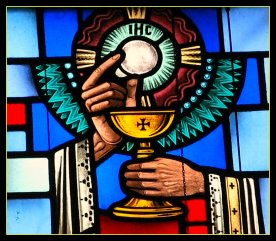
“All the sacraments have a deifying purpose: Baptism introduces the Divine Life into us. Confession restores it when it’s lost through sin. Confirmation strengthens it. Matrimony and Holy Orders give it vocational direction. Anointing of the Sick prepares us for the transition to our heavenly homeland. And the Eucharist is meant to Christify us.” – Bishop Robert Barron
Dear Reader,
Here we are… You and me, together… We have arrived at, not only my absolute FAVORITE chapter of The Bible, but at one of the most important, yet sadly misunderstood teachings of the New Testament… To recap from my last article, I left you to reflect on the following point… “In our short lives here on this earth, there is nowhere else that we should desire more to exist, than at the Mass actively participating in The Eucharist. How do I know this? Because Jesus Himself tells us so in Sacred Scripture…”
So now that you’ve had time to reflect on this, let’s dive in!
Jesus starts what is most commonly referred to as The Bread of Life Discourse in John 6:22. The crowds have followed Jesus because they were hungry for more food since they had experienced Jesus’s recent miracle of the multiplication of the loaves. Something else to note is that this is all occurring around the time of Passover (see John 6:4).
In verse 35 Jesus says “…I am the bread of life; whoever comes to me will never hunger, and whoever believes in me will never thirst.” Okay, so if Jesus had just left it at that, I could see how it might be taken as a metaphor, but Jesus doesn’t leave it at that does he? In verse 41 we see that the Jews were murmuring about him because he told them that he was “the bread of life”. A short while after that, what does Jesus do? In verse 48 He reiterates that he is the bread of life and then intensifies His somewhat colorful message by saying… “Your ancestors ate the manna in the desert, but they died; this is the bread that comes down from heaven so that one may eat it and not die.” What is Jesus saying here? He’s comparing this new bread to the manna in the desert which God gave to the Israelites during their journey of deliverance from Egypt to the promised land…
As we discussed in Isn’t It Just Bread? (Part II) we know that the Jews were waiting for a new Exodus, thus why it is reasonable to have a new Passover that takes us back to that Passover feast on the night which Jesus was betrayed. So if we understand that Jesus established a new Passover meal, it stands to reason that Jesus would give us food to sustain us during our journey to the new promised land.
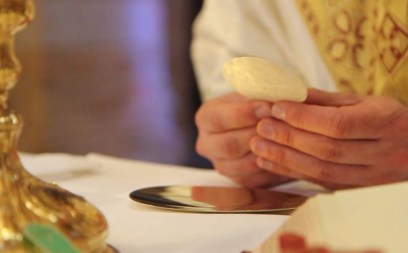
Immediately after this, just when you think this is as intense as it can get, WHAMMO! Jesus hits us with his words in verse 51… “I am the living bread that came down from heaven; whoever eats this bread will live forever; and the bread that I will give is my flesh for the life of the world.” Ummm… WOW!!! Even the Jews are baffled because right after this we see that they start quarreling among themselves and asking each other “How can this man give us his flesh to eat?” Then… WHAMMO AGAIN!!! Jesus says something absolutely unthinkable in the next verse… In verse 53 He says “Amen, amen (which is Bible speak for… ‘hey! listen up!’) I say to you, unless you eat the flesh of the Son of Man and drink his blood, you do not have life within you. Whoever eats my flesh and drinks my blood has eternal life, and I will raise him on the last day.”
“For my flesh is true food, and my blood is true drink. Whoever eats my flesh and drinks my blood remains in me and I in him.” – John 6:55-56
After Jesus gets done saying all of this, in John 6:60-61 we see that Jesus’ disciples say “This saying is hard; who can accept it?” and Jesus, who knows that they’re murmuring about him and what he just said, says: “Does this shock you?” Then he asks them in verse 62… “What if you were to see the Son of Man ascending to where he was before?” Another way to put it could be: “Oh, well if you think this is wild, you ain’t seen nothing yet!” Most Bible commentaries on this verse agree that he’s probably referring to His future ascension up to heaven…
But is it only His ascension that he’s alluding to? I do not believe so… I believe Jesus is essentially using those words to remind His followers who He is and where He came from… Almost as if to say, “I came from heaven and I am God, so it’s not hard for me to change bread and wine into my own body and blood”…
So… let’s recap and see what the Jews following Jesus are up to at this point… We see that in John Chapter 6 verse 41 the Jews are “murmuring” about Him and then in verse 52 they’re “quarreling”… Does it sound to you like they think Jesus is speaking symbolically?
Nope, me neither…
Finally, what’s the most important thing to notice about all of this? Look at John 6:66… Jesus has told them, rather plainly and with increasing intensity, that those who want to follow Him MUST eat his flesh and drink his blood or they will not have life within them…
In verse 66 we see his disciples starting to LEAVE him… These are people who have given up their lives and left everything they have to follow Jesus… And now they’re leaving him over this one little thing… Do you really think that they would leave Jesus, someone they’ve given everything in their lives up for, due to a misunderstanding over symbolic statements?
Ask yourself this… Is a symbolic statement one that is hard to accept as symbolic? (Hint: No…)
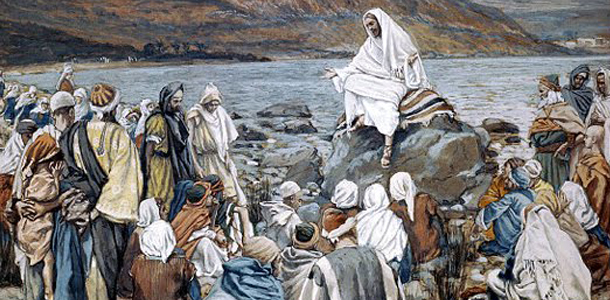
Did you know that this is THE ONLY place in sacred scripture where Jesus’s followers leave him over an issue with one of his teachings? Remember that God gave us free will and it’s because of this that Jesus is staking the future of his whole church on this one point of fact. You would think, that if he’s losing followers, his own disciples no less, because of what he’s said, that NOW would be a good time for him to say something like “Amen Amen I say to you I was only speaking symbolically!” But does Jesus do this? NOPE!
What happens next hit me like a sack of bricks the first time I noticed it… In verse 67 Jesus then says to the twelve apostles… “Do you also want to leave?” Jesus risks EVERYTHING… His ENTIRE MINISTRY on this teaching… I don’t think that Jesus could give us any clearer of a message… So what is this message? What is it that you and I are supposed to take away from Jesus’ words here?
This is a hard pill for most people to swallow. I mean just look at the disciples… They left Him! Over the centuries, this is where many people have “gotten off the train” so to speak… Why? Because this is where it gets personal for all of us… It is something I had to wrestle with myself, especially during my journey when it felt as if I was losing my family… There came a point when I had to make a decision about whether to pursue the truth of Christ’s words as handed down by The Church or whether to just let it go with the hope that God would have mercy on me and understand my choice to protect my marriage… Jesus’s message is simply this…
If I don’t want The Eucharist… I don’t want Jesus…
Let me say it again…
IF I DON’T WANT THE EUCHARIST…
I DON’T… WANT… JESUS…
Jesus makes it clear from his question posed to the apostles in verse 67 that if we don’t want Him in the Eucharist, we’re welcome to walk away… Obviously this would be sad for Him, but Jesus is saying in response to his disciples leaving, that His words in John Chapter 6 are a truth that he is unwilling to bend or compromise on…
“There is nothing so great as the Eucharist. If God had something more precious He would have given it to us.” – Saint John Vianney
Now, dear reader, you may say “Oh but the music at this other church is so good”; however, Jesus’ words remain the same… If I don’t want The Eucharist… OR “Oh, well the preacher down the street is so much better than the priest at my Catholic Church”… Once again, if I don’t want The Eucharist…
It does not matter whether or not we understand it… This is where faith comes in… Just look at Peter’s response in verse 68 after Jesus asks the apostles if they want to leave (I LOVE this!)… “Simon Peter answered him, ‘Master, to whom shall we go? You have the words of eternal life’.” Peter doesn’t say “oh yeah I understand all about transubstantiation” or “I completely get it Lord”. No, he doesn’t say any of that! All he can say is that he has faith in Jesus and his words and that he’s willing to follow Him…
Now, this is NOT to say that Protestants or those who don’t believe in the real presence of Christ in The Eucharist are evil or going to hell or anything like that… I know A LOT of Protestants who are absolutely on fire for Jesus and I think a lot of Catholics can learn from their fervor. For many people the truth of Jesus’ teaching in John 6 is something that they’ve never heard in its proper context, as understood by the earliest Christians, or maybe just never gave any thought to…

I actually own a Protestant Interpreter’s Bible set as well as several Bibles with Protestant footnotes in them and none of them agree on what Jesus’ words mean when taken in a metaphorical or symbolic sense… All of them say something different and I propose to you, my dear reader, that the reason for this is because when such important words from Jesus are taken out of context, it is then necessary to formulate a new interpretation which conforms to the ideas of the interpreter… Once that happens it doesn’t make sense anymore and the truth of His words are lost…
We have to have faith and we have to try and understand his words from Sacred Scripture in their proper context… Once again, going back to something I’ve said before… This is exactly why sola scriptura (scripture alone) ultimately does not and cannot work… With the Living Word, we must have a Living Voice of Authority as our guide… This is why Christ left us His Church… He didn’t leave us The Bible, He left us The Church… The earliest Christians from Jesus’s time understood His real presence in The Eucharist and that has been maintained since the time of the Apostles within The Catholic Church…
One of my favorite songs is called “The End and The Beginning” by Matt Maher (he’s Catholic by the way) and I LOVE the opening line… “If everything that the Roman Catholic Church taught were true… What difference would it make in our lives? We believe that at every single mass, through the power of the Holy Spirit, that the bread and the wine are transformed into the flesh and blood of Jesus!”
“Since Christ himself said, ‘This is my body’, who shall dare to doubt that it is His body?” – Saint Cyril of Jerusalem
In other words, within The Catholic Church, Jesus’ words in John Chapter 6 are made a reality for everyone who believes in Him so that we may never go hungry and never thirst…
Until next time dear reader…
Your Humble Servant In Christ,
William
 William's Catholic Journey
Great message; great presentation. The Holy Spirit is speaking through you. You and your family are blessed🎇
LikeLiked by 1 person
Thank you Mike!
LikeLike
Well written Willie! Thank you for sharing your thoughts!
Amy
LikeLiked by 1 person