

Hello there Dear Reader!
It has been awhile, I know… And for that I am truly sorry. It seems that between work and every other aspect of my life, I just haven’t had the time that I’ve needed in order to write this article, until now of course!
In my line of work as a Realtor, I tend to spend a good portion of my time on my phone. In spending all of this time on the phone, I can’t help but think about how the game “Telephone” can be related to my search for truth and the finding of that truth within The Catholic Church.
If you’ve ever played this game, then you probably remember that the further away the message travels away from the person who received the original message, the more distorted, garbled and just plain changed that message becomes as it is passed further down the line of people… Now, that could happen because someone misunderstood the message given to them and thus they fill in the gaps of their understanding with words that make sense to them… OR it could be because someone wants to control the message and thus intentionally changes the message they heard. In the game scenario, this usually results in some hilarious misunderstandings and misinterpretations… But in what I am about to talk about, we should not find it funny in the least…
During my journey home to The Catholic Church, I discovered that it has something that no other church or ecclesial community has… The Magesterium guided by The Holy Spirit. It is because of The Holy Spirit and Apostolic Authority granted by Jesus Christ to His Apostles (and the passing down of that authority over the centuries) that The Catholic Church can claim the authority to infallibly interpret God’s word.
“You cannot then deny that you do know that upon Peter first in the city of Rome was bestowed the episcopal cathedra, on which sat Peter, the head of all the apostles (for which reason he was called Cephas), that, in this one cathedra, unity should be preserved by all.”
St. Optatus of Milevis (AD 367)
Does it not make sense that IF God gave us an infallible document (which we call The Bible) that he would also give us an infallible interpreter of that document (The Church with guidance from the Holy Spirit)? I hear all the time… “Anyone can understand the Bible as long as they have the Holy Spirit!” OR something like… “God intended for everyone to personally interpret the Bible for themselves.” I’m going to take an example I heard a long time ago (I don’t remember who I heard it from) and show you how inaccurate relying on personal interpretation can be… Check this out…
Slowly read each line below and emphasize the italicized word…
- I never said you stole money. a.k.a Someone else said it…
- I NEVER said you stole money. a.k.a I didn’t ever say it…
- I never SAID you stole money. a.k.a I thought it but never said it…
- I never said YOU stole money. a.k.a I said someone else stole it…
- I never said you STOLE money. a.k.a I said you borrowed it…
- I never said you stole MONEY. a.k.a I said you stole something else…
How many ways can the statement above be understood? As you can see, I came up with six… Six different meanings gotten from a simple statement depending on the author’s tone in how it is supposed to be read… Obviously if we apply this logic to reading Sacred Scripture, we won’t find the appropriate words italicized to let us know where emphasis should be added… With that being said you can see how easy it would be to misinterpret the meaning of certain passages within Scripture and why it it is not illogical or unreasonable that God would see fit to provide us with an authoritative voice for His Word after Jesus’ Resurrection.
Wherever the bishop appears, there let the people be, even as wheresoever Christ Jesus is, there is the catholic church.
St. Ignatius of Antioch (circa. 107 AD)
And if that doesn’t make you stop and think… All we have to do is look at history. If we look at history over the last almost 2,000 years we must ask ourselves this question… “When was my church started and who started it?” There are thousands upon thousands of Protestant denominations today with innumerable divisions within each denomination (and more popping up all the time), but I’ll only focus on six mainstream denominations for this article (otherwise I’d be typing for months and you’d never read to the end)… I prefer to think of each denomination as yet another “person” in a long line of a game of telephone…
- Church of Christ: Early 19th Century – Thomas Campbell, Alexander Campbell and Barton W. Stone. Founded during the “Restoration Movement” in the early 19th Century. Their goal is to “restore the whole Christian Church on the doctrine set forth in the New Testament and believe that they were restoring apostolic Christianity. However, this movement eventually broke apart into different groups…
- Methodism: Began in 1736 by John and Charles Wesley. On April 23rd, 1968 The Evangelical United Brethren Church and The Methodist Church united to form a new denomination called “The United Methodist Church”. It is interesting to note that every four years, a General Conference is held… During General Conference, delegates discuss and vote on petitions and resolutions proposed by individuals, agencies, annual conferences, and other groups within the denomination. These actions result in a revision of the Book of Discipline, the denomination’s book of law, and Book of Resolutions, policies of the denomination on current social issues.
- Baptist: 1609 – 1611 – John Smyth and Thomas Helwys. It’s interesting to note that prior to his death in 1612, John Smyth was “excommunicated” by Helwys from the Baptist congregation for leaving and joining the Mennonite Church… Interesting that one of the main founders of this movement chose to leave it…
- Presbyterian: 1560 – John Knox – The Presbyterian Church is heavily influenced by the theology of John Calvin.
- Episcopalian: 1558 – Elizabeth I – The American Episcopalian church maintains close ties to the Church of England and is heavily influenced by the Protestant Reformation. While Henry VIII started the movement of bringing the Church in England under control of the monarchy (by destroying monarchies and threatening death to Catholic priests who didn’t swear allegiance to him), the church was made official under the rule of Elizabeth I.
- Lutheranism: 16th Century – Martin Luther – It is interesting to note that Martin Luther founded his new religion based on “Sola Scriptura” Scripture Alone and yet he excommunicated those from his church who disagreed with his interpretation of the scriptures… Oh yeah, and he removed 7 books from the Old Testament (up until that point it had been agreed upon that those books were included in the canon via the guidance and inspiration of the Holy Spirit… Guess the Holy Spirit made a mistake the first time around… So glad Martin Luther caught that mistake!)
And finally…
- The Catholic Church: 33 – 36 A.D. – Jesus Christ – The Catholic Church (including our Orthodox brothers and sisters) is THE ONLY church that can back up its claim to have been started by Jesus Christ Himself and His Apostles… Now, if you are a Protestant reading this article, you may say “William, that’s a pretty bold statement and extremely offensive.” And I’m sorry if that offends you but the fact is that the truth is often hard for us to swallow… If it is what I believe to be the truth, then it is my duty to share it with you.
If you disagree with me, then here is my challenge to you my dear reader… Find me proof that what I have said is incorrect… Find me another church that can back up its claim to have been the actual church started by our Lord and Savior Jesus Christ and His Apostles, and I will join that church instead…

St. John Chrysostom (c. 347 – 407)
Do you know why there are so many Protestant Churches a.k.a so many players in the game of telephone that seem to have their own message? It is a result of scandal and division along with the love of private interpretation of the Scriptures which means that instead of conforming to Christ’s Church that HE founded, it has been deemed “okay” to conform Christ to one’s own thoughts and shape Him how an individual thinks Christ should be viewed… Whether or not the founders of each denomination misunderstood the message or intentionally changed the message to fit their own beliefs is certainly a subject for debate in some cases more than others.
Now, obviously the whole analogy of the telephone game oversimplifies the history of splits and schisms within Christianity, but I do believe it is a somewhat relevant analogy… Besides, the point of this particular article is simply just to share my thoughts with you my dear reader. I’m sure you can think of much better analogies than this one.
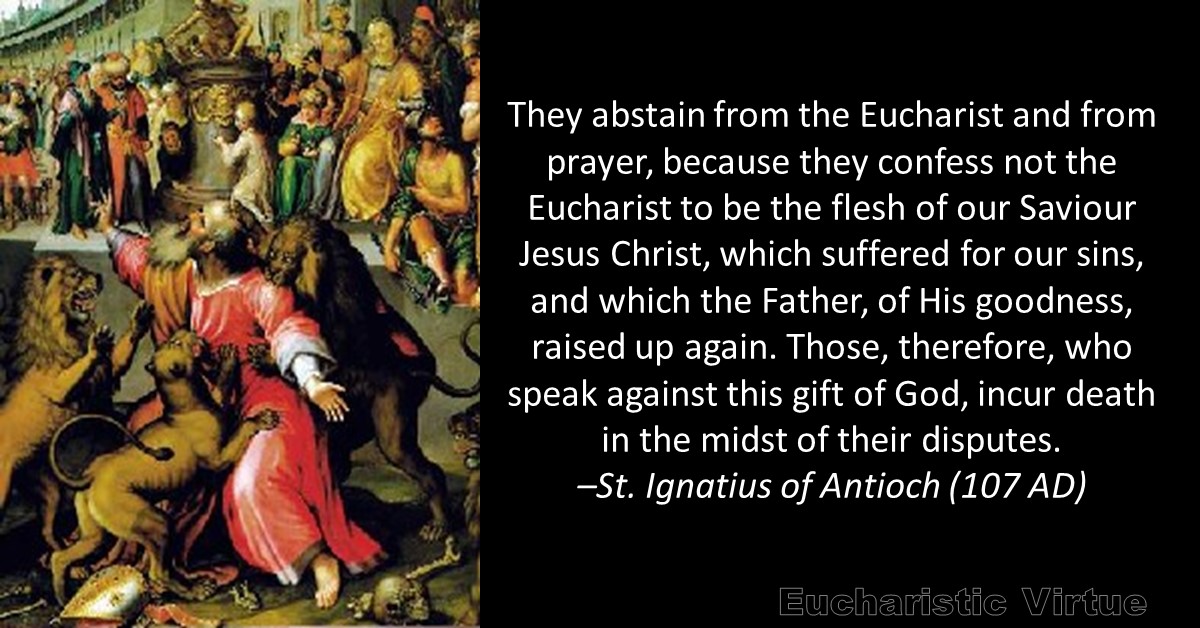
As I’ve conveyed in previous articles, please know that I love my Protestant brothers and sisters with all my heart and I do not believe, that simply because one is not Catholic does not mean they’re damned for all eternity… Every Protestant denomination has at least partial truth within it. Check out my previous article titled “Isn’t Catholicism Just One More Denomination?”. But I do caution everyone to take Jesus’ words seriously in John 6:54-56… “He who eats my flesh and drinks my blood has eternal life, and I will raise him up at the last day. For my flesh is food indeed and my blood is drink indeed. He who eats my flesh and drinks my blood abides in me and I in him.” The only place the true body, blood, soul and divinity of Christ can be found in The Eucharist is The Catholic Church…
I leave you with one final thought utilizing the analogy I have shared with you today… With regard to The Catholic Church, through her Apostolic Authority and according to testimony of the early church fathers… Receiving God’s Word from The Church is as if we were receiving it from the 1st person who relayed the original message during a game of telephone… Jesus said: “And I tell you, you are Peter, and on this rock I will build my Church, and the gates of Hades shall not prevail against it.” – Matthew 16:18 Just something to think about!
“The mixed cup [wine and water] and the baked bread receive the Word of God and become the Eucharist, the body of Christ, and from these the substance of our flesh is increased and supported.”
St. Irenaeus of Lyons (AD 189)
Until next time dear reader…
Your Humble Servant in Christ,
William
 William's Catholic Journey